All calculators
CMU wall installed cost estimator

Concrete Block Wall Cost Calculator

Estimate the installed cost for a standard concrete, cinder, or CMU block wall from wall size, block price, and labor rate.

Default sample is ready

Input

20 x 8 ft

Installed cost

$2,734

Labor basis

Per square foot

Assumes a 20 x 8 ft wall, no openings, 10% waste, and editable national-average prices.

Estimate Installed Wall Cost

Use this for the wall body cost: concrete blocks, 80-lb premix mortar, optional grout, and masonry labor. It does not include footing, permit, demolition, waterproofing, or engineering fees.

Current installed cost

$2,734

national-average

Materials

$814

Labor

$1,920

Cost per sq ft

$17.08

20 x 8 ft wall, about $17.08 per sq ft.

Common budget inputs

Labor Cost Basis

Regional Cost Defaultsnational-average

Using national-average prices. Blank, unknown, or unsupported ZIP codes fall back to this budget baseline.

Advanced assumptions

How much does a concrete block wall cost?

For a standard concrete, cinder, or CMU block wall, most budget estimates fall around $15 to $30 per square foot installed, or about $80 to $240 per linear foot for a 6 to 8 ft wall. Use those as planning ranges, then replace the default block, mortar, grout, and labor prices with local quotes.

These ranges describe the wall body: blocks, waste, joint mortar, optional grout, and masonry labor. Footing, foundation work, permits, demolition, waterproofing, veneer, engineering, inspections, and structural approval can change the final contractor price.

Planning cost ranges

The calculator gives the better answer for your wall. These ranges help you judge whether the result is in the right band before you call suppliers or masons.

Installed cost per square foot

$15 to $30 / sq ft

Usually lower when
Straight walls with easy access, common 8x8x16 blocks, few openings, no core fill, and a mason pricing a larger wall by area.
Usually higher when
Small jobs, tight access, extra corners, partial grout, higher regional labor, or walls that need more layout time per square foot.

Installed cost per linear foot

$80 to $240 / linear ft for a 6 to 8 ft wall

Usually lower when
Lower walls and fence runs usually sit near the low end because each foot of length carries less wall area and fewer blocks.
Usually higher when
Taller walls, foundation or basement work, more openings, and higher labor markets push each linear foot upward.

Concrete or cinder block price

$2.50 to $5.00 / standard block

Usually lower when
Basic gray concrete block bought by the pallet from a nearby supplier keeps the per-block material price down.
Usually higher when
Small orders, specialty faces, heavier CMU, delivery charges, and local shortages can lift concrete block price and cinder block price.

Masonry labor basis

$10 to $18 / sq ft or $45 to $85 / linear ft

Usually lower when
Open sites, simple straight runs, repeatable courses, and a larger job size make the labor basis easier to price.
Usually higher when
Small minimum charges, difficult access, curves, corners, cleanup, and quote structures tied to height raise the labor allowance.

Optional core fill / grout add-on

$2 to $6 / sq ft of grouted wall area

Usually lower when
A few reinforced cells or bond-beam areas add less grout and handling than filling every block core.
Usually higher when
All-cell grout, ready-mix minimums, pump access, higher grout prices, and more reinforced sections move the add-on higher.

See how the wall cost is built

The calculator works best when the budget path is visible: wall size, deductions, material assumptions, labor basis, and excluded work each change the installed cost in a different way.

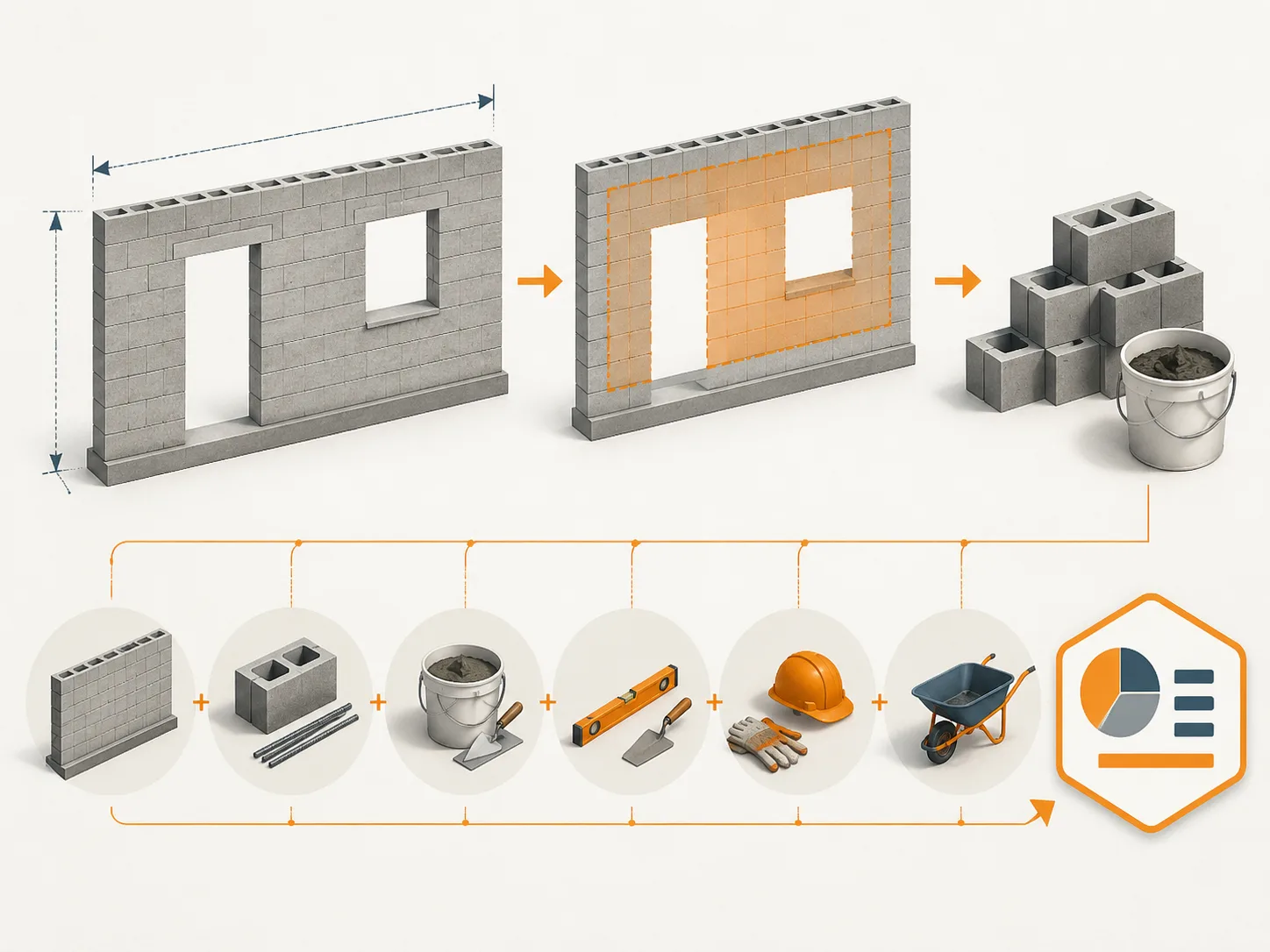
Concrete block wall cost build-up showing dimensions, opening deductions, blocks, mortar, optional grout, labor tools, and installed cost.

From wall size to installed cost

Start with wall length and height, deduct openings, then price blocks, joint mortar, optional grout, and masonry labor for the remaining wall body. The result changes when an opening, waste allowance, material price, or labor basis changes.

Follow the path from net wall area to blocks and mortar, optional grout, masonry labor, and the installed cost result.

Where common block wall projects land

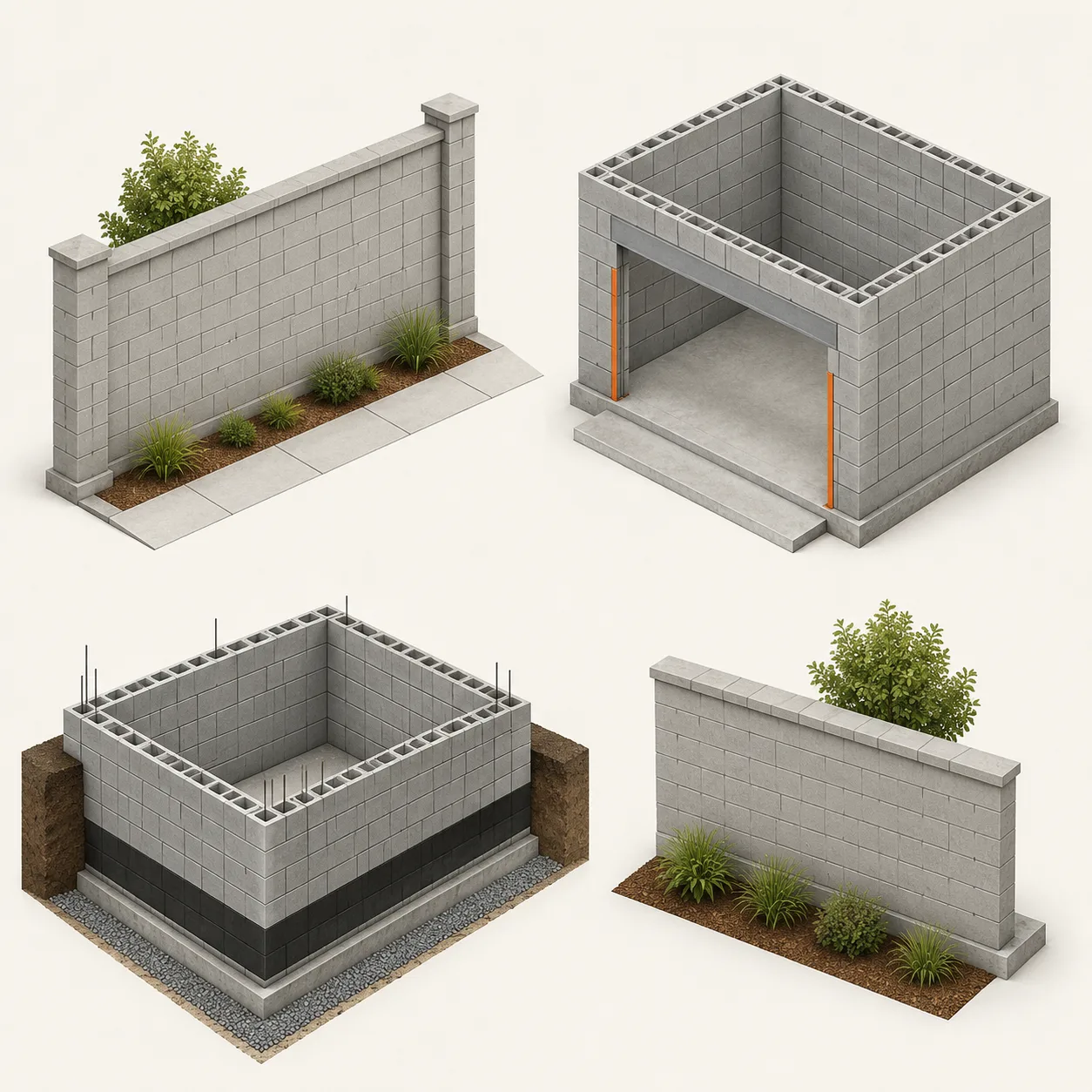
The same block wall cost calculator can cover several ordinary concrete, cinder, or CMU wall jobs, but the project type changes which side of the range is more realistic.

Four ordinary concrete block wall project types shown as isometric masonry scenes.

Match the estimate to the wall type

Choose the project type that most closely matches the wall body before comparing cost per square foot or cost per linear foot.

Freestanding block wall or fence wall

A straight fence wall is usually easier to price because length and height drive most of the work. Costs rise when the wall is taller, has pilasters or returns, needs more grouted cells, or sits where crews have to stage material by hand.

Garage or shed wall

Garage and shed walls usually include wider openings and more coordination with slab, roof, or framing work. The calculator deducts door and window area, but lintels, frames, anchor details, and trade scheduling can make the job price higher than a plain wall.

Foundation or basement wall

The wall body can still be estimated here, but grade, excavation, waterproofing, inspections, rebar design, and concrete footing requirements often drive the real quote. Use the result as the masonry wall body allowance only.

Short garden or privacy wall

A short straight garden wall or privacy screen often lands lower because it uses less height and can be laid quickly. Decorative block, caps, curves, stepped grades, and poor access add layout time and move the budget higher.

What changes your estimate

Wide price ranges are normal because a concrete block wall cost is built from several editable assumptions, not one national price.

Why the same wall area can price differently

Two walls can have the same wall area and still produce different concrete block wall cost results because the calculator separates openings, waste, mortar, grout, labor basis, ZIP defaults, and exclusions instead of hiding them in one average.

Openings change more than block count

A door or window lowers net area, so it can reduce block count, square-foot labor, and cost per square foot. It does not automatically lower every quote because lintels, frames, flashing, and installation stay outside the wall body estimate.

Waste changes purchase safety and material cost

Waste is purchase safety. A higher allowance buys extra blocks for cuts, breakage, and layout changes, which raises total material cost even when wall dimensions stay the same.

Core fill changes material cost, not design approval

Core fill or grout adds cubic yards and grout price to the material estimate. The setting helps budget no core fill, partial cores, or all-cell grout, but it is not a structural design, rebar spacing plan, or approval to build.

Labor basis changes what the rate measures

Per square foot pricing follows net wall area after openings. Per linear foot pricing follows wall length, so two walls with the same area can price differently when one is shorter and taller or when a mason quotes a wall run.

ZIP defaults are broad planning tiers

ZIP code only chooses broad planning tiers for the editable defaults. The defaults are not live local supplier prices, not contractor quotes, and not a replacement for checking current block, mortar, grout, and labor rates near the job.

Wall body cost is not a complete contractor bid

The result is wall body cost for blocks, mortar, optional grout, waste, and masonry labor. A complete bid may add footing, foundation work, permits, demolition, waterproofing, veneer, finishes, engineering, inspections, and structural approval.

How the Concrete Block Wall Cost Is Calculated

After the planning ranges, the formula is straightforward: this CMU wall cost calculator starts with wall body math, then adds editable prices and labor. Use it to calculate cost of concrete block wall projects before asking suppliers or contractors for final quotes.

Net wall area

net area = max(0, wall length × wall height - openings)

Doors, windows, and custom openings are deducted before block count, material cost, square-foot labor, and cost per square foot are calculated.

Blocks and waste

blocks = ceil(ceil(net area × 1.125) × (1 + waste %))

A typical 8 x 16 inch nominal CMU face covers about 0.889 square feet, or 1.125 blocks per square foot. Waste adds ordering safety for cuts, breakage, and small layout changes.

Materials

materials = blocks × block price + mortar bags × bag price + grout cu yd × grout price

Materials include blocks, joint mortar, and optional grout. Mortar uses one 80-lb bag per 12 final purchase blocks and rounds up. Partial core fill uses a 25% allowance; all cells use the 8-inch CMU benchmark of 100 blocks per cubic yard before waste.

Labor and installed cost

installed cost = materials + labor

Labor can be priced per square foot of net wall area or per linear foot of wall length. The result also reports installation cost per square foot and per linear foot.

The $3.25 block price, $10 per 80-lb mortar bag, $180 grout price, $12 per square foot labor rate, and $55 per linear foot labor rate are editable national-average planning baselines. They are not live prices. ZIP code defaults only apply broad regional cost factors to block, mortar, grout, and labor prices.

Sources and planning basis

Last reviewed July 2026

Technical references support the quantity assumptions. Published cost guides only cross-check the broad planning ranges and are not live price authorities.

  • CMU face size: CMHA CMU-TEC-001 supports the typical 8 x 16 inch nominal CMU face used for the wall-area conversion.
  • Mortar coverage: The QUIKRETE Mortar Mix data sheet lists up to 13 standard 8x8x16 blocks per 80-lb bag. This calculator uses a more conservative purchase allowance of one bag per 12 blocks.
  • Grout yield: The Fairbanks Materials supplier table lists 100 standard 8-inch blocks per cubic yard when all cells are filled.
  • Homewyse planning guide: Used only to cross-check the broad consumer planning range. It is not a live price authority or a local quote.
  • HomeGuide planning guide: Used only to cross-check the broad consumer planning range. It is not a live price authority or a local quote.
  • Housecall Pro planning guide: Used only to cross-check the broad consumer planning range. It is not a live price authority or a local quote.

What This Cost Page Does Not Price

This page is for the wall body of a standard concrete, cinder, or CMU wall. It is not a retaining wall cost calculator. Retaining wall cost depends on base gravel, drainage backfill, cap blocks, setback, and different installation assumptions.

Block wall body only

The estimate covers blocks, joint mortar, optional grout, waste, and masonry labor for the wall body. It does not include footing, foundation, demolition, waterproofing, veneer, paint, or cleanup.

Regional defaults are broad

ZIP code adjusts the default prices with a low, average, high, or very-high cost tier. It is not a live local supplier price or a contractor quote.

Openings reduce wall area

Openings reduce block count and square-foot labor because the masonry wall body is smaller. They do not price lintels, frames, flashing, or door and window installation.

Permits and engineering are excluded

Permit fees, structural design, rebar spacing, inspections, and code approval depend on the project and local rules, so they stay outside this budget calculator.

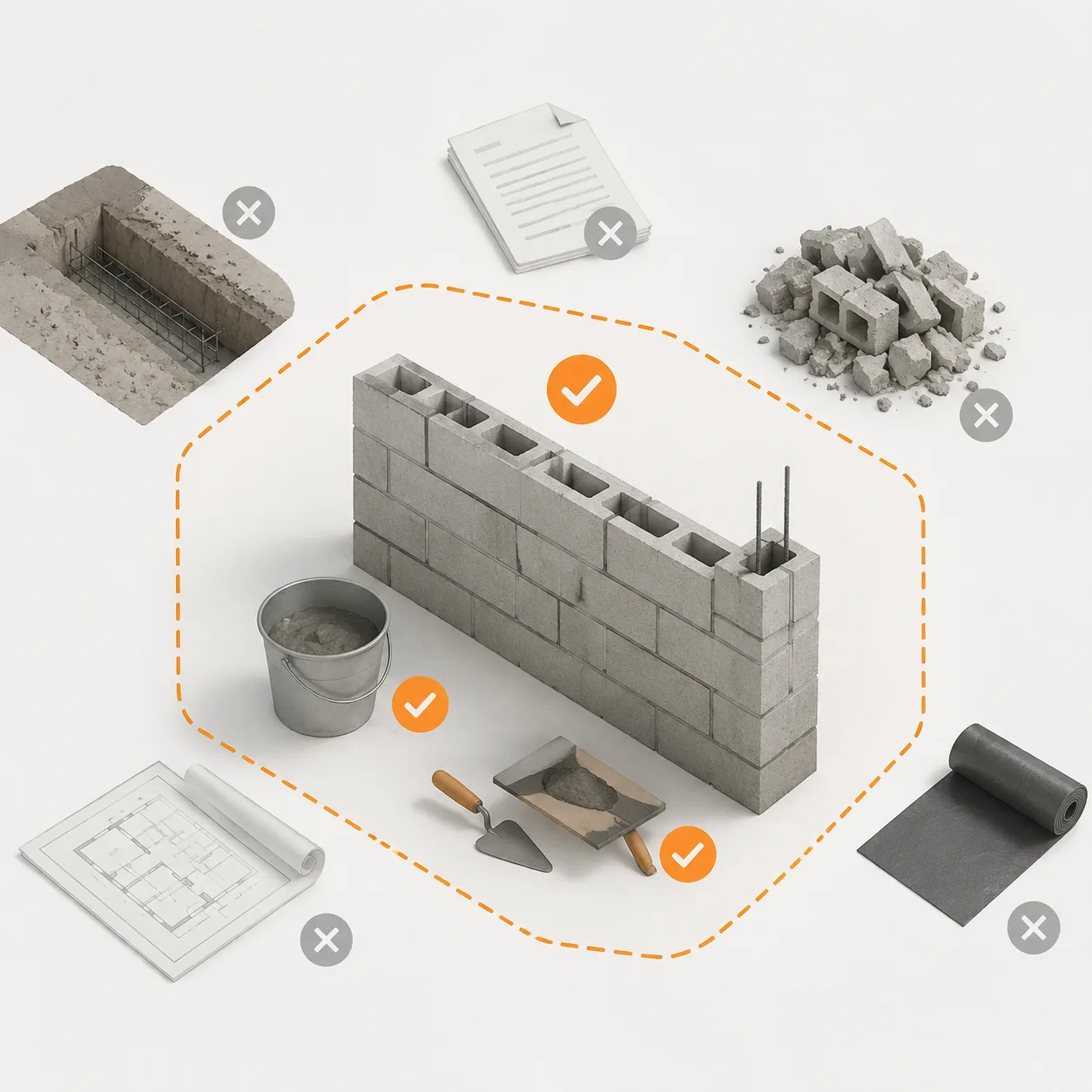
Block wall scope boundary with blocks, mortar, optional grout, and labor included, while footing, permits, demolition, waterproofing, engineering, and retaining wall work are excluded.

Know what stays outside the wall body

The included wall body covers blocks, mortar, optional grout, and masonry labor. Footing, permits, demolition, waterproofing, engineering, and retaining wall work stay outside this calculator.

The wall body includes blocks, mortar, optional grout, and masonry labor. Price footing, permits, demolition, waterproofing, engineering, and retaining wall work separately.

Frequently Asked Questions

What is concrete block wall cost per square foot?
A standard concrete block wall often lands around $15 to $30 per square foot installed for the wall body. Simple straight walls with easy access sit lower. Small jobs, higher labor markets, grouted cores, more corners, and harder access sit higher.
How much is cinder block wall cost per linear foot?
For a 6 to 8 ft cinder block wall, a planning range of about $80 to $240 per linear foot is common. Height, block price, labor basis, openings, waste allowance, and optional grout all change the number.
What block price should I enter?
A basic 8x8x16 block often falls around $2.50 to $5.00 per block before delivery, taxes, or special finishes. Use that as a starting point, then enter the price from your local supplier for a better whole-wall estimate.
How accurate are the default concrete block wall cost values?
The defaults are budget-level national averages, not live prices. They are useful for a first concrete block wall installation cost estimate, but you should replace the block price, mortar bag price, grout price, and labor rate with local supplier and mason quotes before buying materials.
What does the ZIP code regional cost factor do?
The ZIP code maps to a broad cost tier and adjusts the editable default prices by a regional factor. Blank, unknown, or unsupported ZIP codes use the national-average baseline. The factor helps start the estimate closer to your region, but it is not a real-time local quote.
Should I use labor cost per square foot or per linear foot?
Use per square foot when your mason prices by wall area, which is common for installed block wall cost comparisons. Use per linear foot when a quote is framed around a wall run with a fairly consistent height. The calculator shows both cost per square foot and cost per linear foot in the results.
Do doors and windows lower the wall cost?
Yes. Openings are deducted from the wall area before blocks, waste, square-foot labor, and cost per square foot are calculated. The calculator does not add lintels, frames, flashing, or door and window installation, so add those separately if they apply.
Does core fill or grout belong in a cinder block wall cost calculator?
Only when your wall design calls for grouted cores. This page can add no core fill, partial core fill, or all-cell grout to the material cost. It is a budget allowance, not a structural rebar or grout spacing design.
What costs are excluded from this estimate?
Footing or foundation work, permits, demolition, waterproofing, veneer, engineering, inspections, and retaining wall work are excluded. Those items can raise a real contractor quote well above the wall body cost shown here.
Is this a cinder block wall cost calculator?
Yes. For this wall body estimate, concrete block, cinder block, and CMU describe the same standard masonry wall task. The same installed cost math applies as long as you enter the correct block price, labor rate, openings, waste, and optional grout.
Can I use this for retaining wall cost?
Use the retaining wall block calculator instead. Retaining wall cost uses a different structure because base gravel, drainage backfill, cap blocks, setback, and different installation assumptions matter more than a plain CMU wall body estimate.
For quantities outside installed cost, use the concrete block calculator, block mortar calculator, block fill calculator, or retaining wall block calculator.